
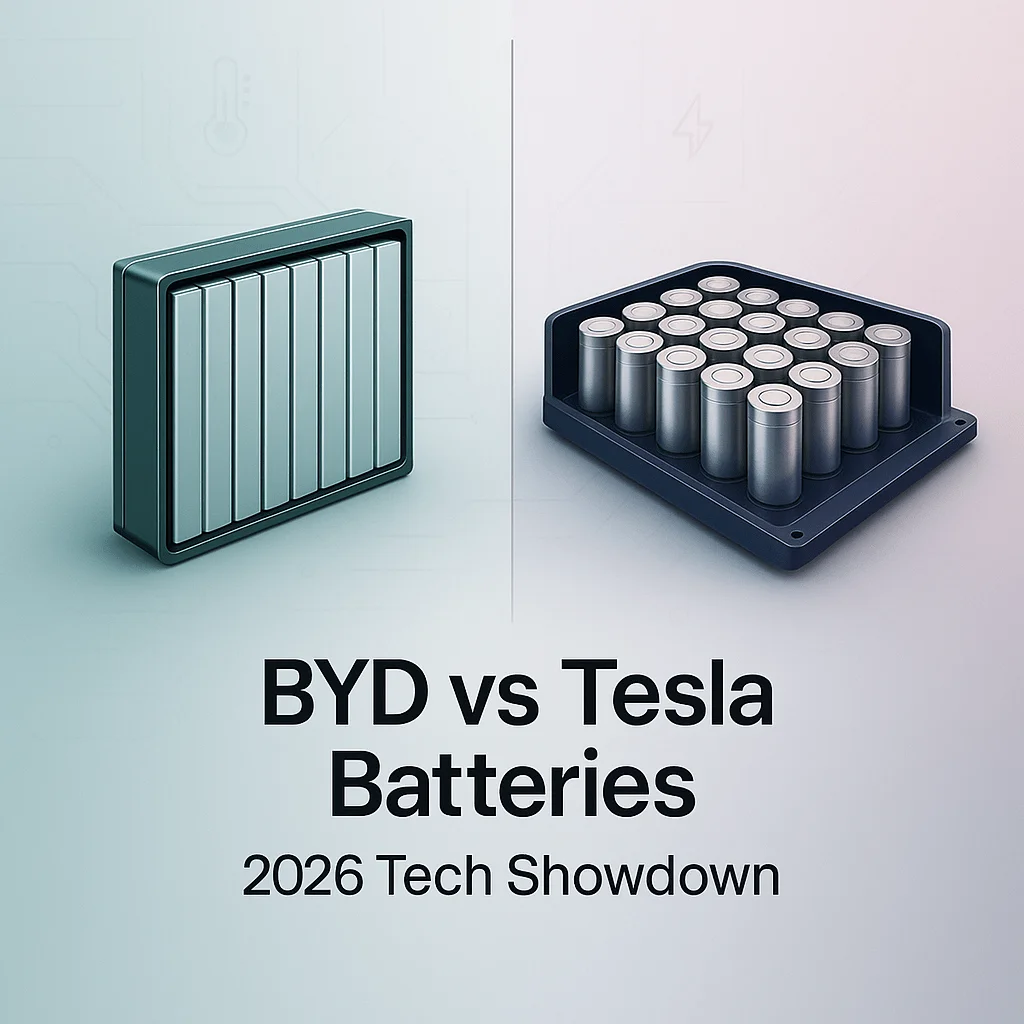
Batteries are still the most expensive, most debated, and most misunderstood part of an EV.
And by 2026, the “BYD vs Tesla” battery conversation is less about who has the best chemistry… and more about who has the best total system: cells, pack design, thermal control, software, supply chain, and (crucially) the charging experience you can actually access in your area.
Let’s break it down in plain English.
The quick verdict: BYD vs Tesla batteries at a glance
If you just want the “tell me what to buy” summary, here’s the most honest way to say it:
- If you care most about value + safety reputation + mainstream durability, BYD tends to win in 2026.
- Why? BYD has scaled LFP like almost no one else, built a strong safety story around Blade Battery, and pairs it with space-efficient Cell-to-Body (CTB) packaging. They also control more of their supply chain, which shows up in pricing.
- If you care most about efficiency + software-managed charging + performance trims, Tesla tends to win in 2026.
- Tesla’s edge is often system-level: energy efficiency (Wh/mi or Wh/km), thermal management, preconditioning, charging UI, trip planning, and how the car behaves under repeat fast charging. In many markets, Tesla also has deeper charging ecosystem integration.
The important nuance: the verdict changes depending on the exact model, trim, and market.
- Tesla does not use one battery. Depending on region and model year, Tesla may ship LFP or nickel-based packs, from different suppliers, in different formats.
- BYD is known for LFP dominance, but it also has multiple chemistries and pack strategies across segments and export markets.
So a fair comparison is never “BYD vs Tesla” in the abstract. It’s “this BYD model/trim in my country vs this Tesla model/trim in my country.”
Battery chemistry 101: LFP vs NMC/NCA in real life
Most EV battery debates eventually collapse into two buckets:
- LFP (Lithium Iron Phosphate)
- Nickel-based lithium-ion like NMC (Nickel Manganese Cobalt) or NCA (Nickel Cobalt Aluminum)
Here’s what they mean without the chemistry lecture.
LFP (Lithium Iron Phosphate)
Think of LFP as the “workhorse” chemistry:
- Typically cheaper to make
- Uses iron (more abundant), and generally avoids heavy reliance on nickel and cobalt
- Usually has excellent cycle life (handles lots of charge/discharge cycles well)
- Generally more thermally stable (important for safety)
Trade-off:
- Often lower energy density than nickel-based cells, meaning you may need more battery weight/volume to get the same range.
Nickel-based (NMC/NCA)
Think of nickel-based as the “high energy” chemistry:
- Typically higher energy density (more range per kg, useful for long-range and performance trims)
- Often better suited to vehicles targeting maximum range without making the pack huge
Trade-offs:
- Usually more expensive
- More exposure to nickel/cobalt supply and price volatility (and ESG scrutiny)
- Can be less thermally stable than LFP (though pack design and software matter a lot)
The 2026 reality: it’s not as simple as “LFP is low range”
By 2026, LFP isn’t “the cheap short-range battery” in the way it used to be. The industry has improved:
- Pack-level design (cell-to-pack, cell-to-body) reduces wasted space and improves structural efficiency.
- Better thermal strategies and charging control make LFP packs feel less compromised for normal driving.
At the same time, nickel-based packs still matter, because physics still matters:
- For long-range trims and performance variants, higher energy density remains a big advantage.
Why “better chemistry” depends on your use case
- If you’re a commuter who charges often (especially at home), LFP can be a perfect match: durable, stable, cost-effective.
- If you do long-distance driving, live in a very cold climate, or want maximum performance, nickel-based packs can still be the better tool—assuming the car manages heat and charging well.
Safety and thermal runaway: why LFP is winning mindshare
People don’t just want range. They want peace of mind.
In general terms:
- LFP is more resistant to thermal runaway than nickel-based chemistries.
- That’s a big reason LFP has become the default for a lot of mainstream EVs globally.
But here’s the part many discussions miss:
Safety is not only chemistry. It’s also:
- Pack structure and crush protection
- Cooling system design
- Venting and propagation barriers
- Battery Management System (BMS) software
- Manufacturing quality and consistency
This is where BYD and Tesla take different routes:
- BYD has leaned heavily into a physical design narrative (Blade) and packaging (CTB).
- Tesla leans heavily into system engineering, software control, and (in some models) structural integration.
We’ll get into both.
Energy density and range: why nickel still exists
If LFP is safer and cheaper, why does the industry still use nickel-based packs?
Because when you’re trying to:
- Maximize range in a limited space
- Build a high-performance variant with sustained power output
- Keep weight down while keeping range up
…energy density still matters.
Also, chemistry doesn’t operate in isolation. Two key nuances:
- Pack design can offset chemistry differences
- A slightly lower-density chemistry in a more space-efficient pack can compete surprisingly well.
- Vehicle efficiency is a “hidden battery upgrade”
- A car that uses fewer Wh/mile effectively makes the same kWh pack go further.
That’s one reason Tesla can sometimes feel like it “has a better battery” even when the chemistry is similar—because the car simply uses energy more efficiently.
BYD battery tech in 2026: Blade Battery and Cell-to-Body (CTB) explained
BYD’s battery story has two major pillars:
- Blade Battery (a form factor + safety-focused approach)
- CTB (Cell-to-Body integration for packaging and structure)
(Note : Pour nos lecteurs francophones, vous pouvez trouver des détails techniques supplémentaires sur la batterie BYD ici).
Blade Battery: what it is, and why it mattered
The “Blade Battery” is BYD’s well-known LFP pack approach using long, thin prismatic cells arranged to improve:
- Space utilization (less wasted volume)
- Structural layout
- Safety narrative (reduced propagation risk, better thermal behavior in abuse scenarios)
The key point isn’t that “Blade is magic.” It’s that BYD treated battery design like a product advantage, not just a commodity component.
Cell-to-Body (CTB): what integrating the pack changes
CTB is BYD’s approach to integrating the battery more directly into the vehicle body structure (rather than treating the pack as a separate box bolted underneath).
Practical impacts can include:
- More usable cabin space (less packaging overhead)
- Improved rigidity (battery structure contributes to chassis stiffness)
- Potential improvements in crash energy distribution and structural behavior
But there are trade-offs:
- Manufacturing complexity can increase
- Repairs after severe underbody damage can be more complicated (depends on design and local service capabilities)
- Accident assessment and insurance processes can vary by market
Where BYD usually leans (chemistry-wise)
In 2026, BYD’s mainstream strength still heavily leans toward LFP for mass-market models.
But it’s also fair to note:
- BYD operates a broad ecosystem and can deploy different solutions depending on segment and market needs.
So: BYD is “LFP-first,” not “LFP-only.”
What Blade’s design changes (and what it doesn’t)
Blade (especially paired with CTB-style integration) tends to improve a few things in the real world:
What often improves:
- Safety characteristics (especially propagation resistance narrative + thermal stability advantage of LFP)
- Packaging efficiency compared to older module-heavy designs
- Longevity potential thanks to LFP’s strong cycle life
What it doesn’t automatically improve:
- Cold-weather charging speed (LFP still dislikes cold fast charging without strong thermal strategies)
- Peak power output for performance trims (depends on the full system: cell choice, cooling, BMS tuning)
So if your goal is “fastest 10–80% on a freezing day” or “sustained high power,” chemistry and pack design are only part of the story.
BYD’s manufacturing advantage: vertical integration as a battery feature
BYD’s not just building batteries. It’s building a large chunk of the stack:
- Cells
- Packs
- Vehicles
- Many supporting components and supply chain relationships
This matters because vertical integration can deliver:
- Lower costs (fewer middle margins, better scaling control)
- Faster iteration between cell, pack, and vehicle teams
- More consistent manufacturing outcomes (in theory—execution matters)
It also reduces exposure to the most volatile materials:
- An LFP-heavy strategy typically means less reliance on nickel and cobalt, which can reduce price shock risk.
What to watch in 2026:
- Scaling globally means scaling quality control, service training, and consistency across factories and markets. The technology can be strong, but buyers still live with local execution.
Tesla battery tech in 2026: 4680 cells, structural packs, and supplier diversity
Tesla’s battery story is less “one flagship battery” and more “an ecosystem.”
Tesla uses multiple suppliers + multiple strategies
Depending on:
- model
- trim
- factory
- region
- year
…a Tesla may come with different:
- Chemistries (LFP or nickel-based)
- Cell formats (including 4680 in some cases)
- Pack configurations
This is why sweeping statements like “Tesla batteries are better” or “BYD batteries are safer” often fall apart in real comparisons.
4680 overview: what Tesla was aiming for
Tesla pursued the 4680 format to improve:
- Cost efficiency at scale
- Manufacturing simplification (in theory)
- Structural integration potential
- Performance and thermal behavior benefits (depending on implementation)
A key concept often mentioned with Tesla is the structural pack:
- The battery pack isn’t just energy storage; it becomes part of the vehicle’s structure, potentially reducing redundant framing and improving rigidity/weight efficiency.
Tesla also uses LFP (often)
In many markets, Tesla has deployed LFP in standard-range trims, especially where LFP supply chains and pricing make sense.
And for long-range/performance trims:
- Nickel-based chemistries are still common because the product goal is often maximum range and power.
Tesla’s system-level advantage
Tesla’s real differentiator is frequently:
- Efficiency
- Thermal control
- Software
- Charging integration
Meaning: even when two cars have similar battery chemistry, the Tesla may feel “better” on long trips because of how it manages energy and charging.
The underrated differentiator: efficiency + software-managed thermal control
A simple truth: efficiency is range.
If Car A uses 15% less energy per mile, it’s like it got a bigger battery—without adding weight or cost.
This shows up in:
- Fewer charging stops on road trips
- Shorter sessions to add the same real-world miles
- Better consistency across conditions (depending on vehicle design)
Software-managed thermal control matters because batteries are picky:
- Too cold: charging slows down, regen limits, range drops temporarily
- Too hot: charging may taper earlier, and long-term degradation risk rises
Tesla has historically been strong at:
- Preconditioning the battery before fast charging (warming/cooling it to the right temperature)
- Managing charging curves and thermal routing to maintain repeatable performance
In real driving, this can matter more than a spec sheet peak kW number.
Supplier reality check: why “Tesla battery” isn’t one battery
If you’re shopping Tesla in 2026, assume variation.
A Tesla vehicle may ship with different cells by:
- trim level (standard vs long range vs performance)
- region (market sourcing)
- model year changes
- factory output differences
How buyers can identify what they’re getting (general guidance):
- Start with trim and published specs
- Look at the model year / build location
- In some cases, enthusiasts use build info or VIN-decoding communities (varies by market and availability)
Implication:
- Always compare a specific BYD model to a specific Tesla model/trim you can actually buy where you live.
Charging performance: BYD vs Tesla battery comparison beyond peak kW
Most battery comparisons online over-focus on peak charging speed.
Peak kW is easy marketing.
What actually affects your life is:
- the charging curve (how long the battery can hold high power)
- 10–80% time
- consistency across repeated sessions
- how often you can hit ideal conditions (temperature + charger availability)
LFP vs nickel charging behavior (broadly)
General trends (not universal rules):
- LFP can be more sensitive to cold fast charging and may taper differently.
- Nickel-based packs can deliver strong performance, but also depend heavily on thermal management to avoid aggressive tapering or heat limits.
Either way, you want to see real-world 10–80% results, not brochure numbers.
Preconditioning and station availability decide your real speeds
Even the best battery can charge slowly if:
- it’s cold and the car doesn’t precondition well
- chargers are crowded or throttled
- you can’t reliably access high-power stations on your routes
This is why battery comparisons should include charging access.
A practical way to keep it real is to plan around actual station availability using a directory like SpotMyCharge—a worldwide EV and gas station directory—so you can judge:
- how dense fast charging is near you
- which corridors are easy vs stressful
- where charging reliability looks strong (or weak)
Because in real ownership, the “best battery” doesn’t help much if the charging infrastructure around you is thin.
Cold weather charging: where many comparisons break down
Cold weather exposes the gaps between:
- chemistry behavior
- thermal management design
- software strategy
In winter, you can expect:
- slower DC fast charging
- reduced regen until the pack warms
- temporary range loss (some of it returns as the battery warms)
What to look for in reviews:
- winter 10–80% time
- consistency after back-to-back fast charges
- whether the car preconditions automatically and effectively
Practical tip:
- On winter road trips, use tools like SpotMyCharge to find stations with higher power and better reliability, so you’re not stuck stretching a session at a slow or congested site.
Home charging vs road trips: which battery feels better depends on your routine
A lot of “Tesla vs BYD battery” arguments disappear once you identify your actual routine.
If you mostly home charge:
- Durability and predictable daily range matter more than peak DC speed
- Efficiency helps, but you’re rarely optimizing 10–80% on a road-trip schedule
- LFP’s tolerance and longevity can be a major comfort factor (again: model-dependent)
If you road trip often:
- Charger network coverage and reliability matter as much as the battery
- Sustained charging curve matters more than peak kW
- Thermal stability over repeated fast charges becomes important
Your geography decides the winner more than people admit:
- Dense urban charging can make almost any EV workable
- Rural corridors can make the “charging ecosystem + planning” the real deciding factor
Battery longevity and degradation: what you can realistically expect by 2026
Degradation is inevitable, but it’s also commonly exaggerated.
Two main types:
- Calendar aging: the battery slowly ages over time, especially when stored hot and at high state of charge
- Cycle aging: aging from repeated charging/discharging, especially under high heat and heavy fast-charging loads
General trends you can rely on (with caveats)
- LFP often shines in cycle life, especially for frequent charging and high-mileage use.
- Nickel-based packs can degrade faster under harsh conditions — but strong thermal management and conservative buffers can narrow the gap significantly.
Why two “same kWh” cars can age differently
A battery pack has:
- total capacity (physical)
- usable capacity (what the car lets you access)
BMS buffers, thermal strategy, and charging curve tuning can mean:
- two packs with similar advertised kWh behave differently over years of use
- one may feel “stable” longer because the manufacturer managed stress better
How to compare in 2026 (without guessing):
- Look for long-term fleet data when available
- Read high-mileage owner reports (ideally with measured capacity)
- Compare warranty terms and capacity retention thresholds
- Don’t over-believe perfect numbers from small samples
Daily charging habits: what changes between LFP and nickel packs
Typical guidance (always follow the manufacturer first):
- LFP packs are often more tolerant of charging to higher state of charge regularly, which can reduce “I need 100% tomorrow” anxiety for some owners.
- Nickel-based packs often prefer lower daily targets (with higher charges used when needed) to reduce time spent at high SOC.
But this is guidance, not a religion: Modern BMS systems protect the pack
If you’re someone who frequently needs high SOC (because you can’t charge at home or have long daily drives), LFP can feel simpler—assuming the vehicle’s winter performance fits your needs.
Warranties and real ownership signals to look for
Most EV battery warranties cover:
- a number of years
- a number of miles/km
- a minimum capacity retention threshold (varies)
They usually do not cover:
- normal, gradual degradation that stays above the threshold
- range loss caused by harsh use patterns that still fall within “normal”
When shopping, look for:
- published capacity retention thresholds (if available)
- independent long-term tests
- reputation for thermal management and charging curve stability
Also remember: resale value in some markets increasingly reflects:
- visible range loss
- evidence of heavy DC fast charging (where data is available)
- buyer confidence in that model’s long-term battery behavior
Safety, crashes, and pack design: Blade vs structural packs
The safest battery is the one that:
- resists thermal runaway
- prevents propagation if something goes wrong
- is mechanically protected in crashes
- is monitored and controlled well by the BMS
BYD angle: Blade’s safety narrative
Blade’s public identity is strongly tied to safety:
- LFP’s inherent thermal stability
- cell form factor and layout designed to reduce propagation risk
- a pack philosophy that emphasizes physical robustness
Tesla angle: structural packs and rigidity (with repair nuance)
Structural packs can improve rigidity and packaging efficiency. However, they can also change repair realities:
- If the pack is more integrated into the structure, severe damage may be more complex to assess and repair
- Outcomes vary by model design and regional service/insurance ecosystem
Balanced truth:
- Real-world safety depends on the whole vehicle: structure, cooling, venting, sensors, software, and quality control—not just “Blade” or “structural pack” headlines.
This is evident when comparing models like the 2006 Honda Civic that have different structural designs and repair implications.
Cost and scaling: which company is better positioned to win on price in 2026?
Battery cost is still the biggest lever in EV pricing.
The biggest cost levers are:
- materials (chemistry choice)
- manufacturing scale and yield (how many cells/packs pass QC)
- supply chain control
- pack architecture (wasted parts/space adds cost)
BYD’s cost position
BYD is structurally well-positioned on price because:
- LFP-heavy strategy lowers reliance on expensive nickel/cobalt
- vertical integration can compress costs and reduce supplier margins
- massive scale helps improve manufacturing economics
This is a big reason BYD often competes aggressively in value segments.
Tesla’s cost position
Tesla’s cost strategy often comes from:
- system simplification
- manufacturing innovation and scaling
- efficiency (which can allow smaller packs for similar real-world usability in some cases)
- supplier diversification and multi-source flexibility
But Tesla’s product mix includes more performance and long-range variants where nickel-based costs can remain higher.
Regional sourcing and regulations matter
In 2026, what battery you get can depend on:
- local incentives and sourcing requirements
- import/export rules
- which factory supplies your market
So you can’t separate “battery tech” from “where the car is built and sold.”
Materials and geopolitics (in plain English): nickel, cobalt, iron, and supply risk
- LFP leans more on iron and phosphate-based materials, generally reducing dependence on nickel and cobalt.
- Result: potentially less exposure to price spikes and supply constraints tied to those materials.
- Nickel-based chemistries still matter because they’re hard to beat for energy density in many long-range/performance applications.
- Result: more complexity in supply chains and, sometimes, higher cost volatility.
In practical buyer terms:
- Value-oriented EVs increasingly go LFP.
- Long-range/performance trims often justify nickel-based cost and complexity.
Real-world ownership: what matters more than the spec sheet
Here’s what most buyers actually experience day-to-day:
- Range consistency (not just maximum range)
- Charging time predictability
- How often charging is convenient
- Total running costs
- How stressful road trips feel
And this is where battery debates often miss the biggest variable:
Charger availability can outweigh small battery differences
If one EV has slightly better chemistry or slightly better pack design, but:
- charging stations are sparse near your home
- the highway corridor you drive is weak
- the stations near you are unreliable or low-power
…then the “better battery” doesn’t translate into a better life.
That’s why it’s smart to include route planning early using SpotMyCharge (a worldwide EV and gas station directory) to:
- find nearby EV chargers you can realistically use
- compare station density on your common routes
- reduce range anxiety regardless of whether you choose BYD or Tesla
If you live in an apartment or rely on public charging
If you can’t charge at home, your bottleneck is access.
In that situation, you should prioritize:
- efficiency (lower Wh/mi means fewer kWh you need to buy)
- a strong charging curve (good real-world 10–80%)
- reliable access to stations near home and work
And you should plan your real charging life before you buy:
- Use SpotMyCharge to quickly locate nearby charging options, filter by what’s available, and sanity-check whether public charging will feel easy or annoying week-to-week.
If you road trip often
Road-trip comfort usually comes from:
- sustained charging curve (not peak)
- thermal stability over back-to-back sessions
- charger network density along your routes
How to evaluate it in your region:
- Map your common corridors
- Check charger spacing and power levels
- Use SpotMyCharge to preview station availability before buying, so you’re not discovering gaps after you’ve already committed
So… which EV tech wins in 2026? A practical way to choose between BYD and Tesla
Instead of picking a winner by brand, use a framework that matches how you actually drive.
Choose BYD if…
- You want maximum value per dollar
- You prefer the LFP safety narrative and generally strong durability profile
- You like BYD’s packaging approach (Blade + CTB concepts) and what it can do for space and structure
- You want a brand that’s positioned to win on cost through scale + vertical integration
In many mainstream segments, BYD’s battery strategy is simply hard to beat on practicality and cost.
Choose Tesla if…
- You want top-tier efficiency and a car that feels optimized as a whole system
- You care about software-managed thermal control and consistent fast-charging behavior
- You road trip often and benefit from strong charging integration (market-dependent)
- You want access to performance variants where nickel-based packs and power delivery still matter
Tesla often “wins” not because the battery chemistry is always superior, but because the full system is tuned to make charging and long-distance driving feel easier.
The buyer-centric takeaway
Battery tech is a big deal—but it’s not the only deal.
In 2026, for most people, the best choice comes down to:
- your driving pattern
- your climate
- your charging access
- your budget
- the exact model/trim battery you’re buying
And before you decide, check your real charging reality. Using SpotMyCharge to view EV charger availability (and gas stations too, if your household runs mixed vehicles) can quickly reveal whether your ownership experience will feel effortless—or like a constant workaround.
Because the “winning battery” on paper doesn’t always win on your street.